In the Summer of 2010 I shall be going to Uganda as a research volunteer on the Semliki Chimpanzee Project. I will spend ten weeks following and studying the chimpanzees of Semliki Wildlife Reserve, learning the ropes as a fledgling chimpanzee chaser. This blog will chart the memorable animals, people and events that I encounter along the way and my experiences with the stars of the trip, the Semliki chimpanzees.

Saturday, 31 July 2010

The frustration of fruitless searching


While there is always something of interest to make our forest visits worthwhile, I am ultimately here for the chimpanzees and it is these that I most want to see. Having seen only brief glimpses of the rear-ends of chimpanzees as they hurriedly move out of sight for almost two weeks now frustration is starting to set in.

Since last Saturday we have searched high and low in nearly every inch of our study site, covering many miles each day in the hunt for our ever-elusive study subjects. In our attempts to catch up with the chimpanzees we have run through savannah, scrambled up hills and pushed through thorn-laden thicket, but we have always found ourselves hot, sweaty and heavily scratched but no closer to our targets.

There are some days when, if I didn’t know better, I would think that the chimpanzees are deliberately tormenting us for their enjoyment. For instance there was the day when we had just stopped for a much needed rest and food break at the top of the huge hill that we had spent most of the morning climbing. We sat enjoying the rest and the stunning view and were just about to start on the food, much to my delight as my stomach was growling with hunger.

Just as we had got the chapatti-filled lunchbox out some leaves rustled in the valley below. Out came the binoculars, and after several minutes of observation I thought I saw the human-like hand of a chimpanzee emerge from behind some branches and grab a piece of fruit. Putting the untouched food away we got to our feet and raced down the valley towards where we thought the chimpanzee would be. We arrived just in time to see it disappear into dense vegetation.

It seems for now that I am going to have to make do with infrequent glimpses of chimpanzee arses. Whilst any sighting is good and even the arse-end of a chimpanzee is of interest, I hope that we will get some more substantial sightings soon!

Written on Friday 30th July

Animal of the week - week 3

Wire-tailed swallow (Hirundo smithii)

The wire-tailed swallow acquires its name from the two long and wire-like tail feathers that the adult birds possess. These extended feathers and their red caps make the adult swallows instantly recognisable as they swoop and dive with incredible speed and agility around the camp.

A pair of the swallows has nested in the eaves of our kitchen hut here and so I often see them collecting insects and ferrying their spoils to the three chicks that they are raising, with seemingly limitless energy.

This week the three fledgling swallows left their nest for the first time and I have loved watching them test their wings and perfect their flying in the kitchen – moving uncertainly from beam to beam, spurred on by the encouragement of their parents and each other.

In addition to being fascinating to watch, these swallows draw my thoughts to home. This is primarily because watching them swoop down from the nest reminds me of the house martins that do this when they nest under the eaves of my house and the delight that myself, my mum and my sister feel when they do so.

The resemblance of the swallow chicks to the martlet – a mythical bird that features in the crest of my college, also makes me thing of university and the lovely friends that I have made there and who I shall not see for a long time yet. I wish that these friends could be here now to share in my joy at watching the swallows.

Instead I shall have to make do with writing about the swallows and to look forward to being able to relate the stories of these birds and the other fascinating animals that I have encountered, and no doubt will continue to encounter, on my chimpanzee chasing adventure.

For the delight that watching them brings, and for the fond thoughts of home, family and friends that they evoke, the wire-tailed swallow has to be my third ‘animal of the week’.

Downpour!

During my time in Semliki there has been a lot of rain, an unusual amount for this time of year, which should be the dry season. But so far this rain has been restricted to the nights and the days have been clear and dry - until today that is.

This morning we had planned to visit a different region of the forest close to the nearby safari lodge as the chimpanzees had recently been calling from there. After the drive to lodge through the steadily falling rain, and the test of Edson’s still-brilliant driving skills that this involved, we arrived to discover that the chimpanzees no longer appeared to be in the area as they had not been heard the previous night.

As we headed back to camp Edson explained to me how difficult it is to find the chimpanzees when it is raining. On these occasions the chimpanzees are typically quiet and hidden sheltered on the ground out of sight. The noise of the rain also makes it difficult to hear any sounds that the chimpanzees do make.

Despite these words of warning we were eager to get into the forest when we arrived back at camp, as we discovered that the chimpanzees had been heard nearby. After over a week of seeing nothing but the briefest of glimpses of the chimpanzees I was willing to take even the remotest chances of finding them.

My initial optimism soon faded when I realised the realities of chasing chimpanzees in the rain. What had started as a drizzle steadily increased as we ventured deeper into the forest, until we were struggling to hear the shaking of branches and the calls of the colobus monkeys above the relentless patter of rain. The storm clouds overhead also meant that the forest was shrouded in darkness so that even if we could have found the chimpanzees we would have struggled to see what they were doing let alone identify them.

After slipping and sliding along the water-logged trails for a couple of kilometres William, today’s UWA ranger, decided that the search should be called off and continued in the afternoon when the rain would hopefully have cleared up. It was as we turned to head for camp that the heavens opened and the already fairly heavy rainfall turned into a downpour.

I was soaked to the bone within seconds and was just glad that I had thought to cover my rucksack with its waterproof cover this morning. We raced back against the flow of water now covering much of the ground and I was soon drenched, splattered with mud and looking and feeling a lot like a drowned rat. Even my feet got wet, as the normally low river was now deep enough to overflow my waterproof boots. We arrived back at camp dripping wet, much to the amusement of everyone sheltered in the dry of the kitchen hut.

This morning’s brief attempt at chimpanzee chasing reminded me of past excursions on Dartmoor and other rain-soaked regions of the UK, and was a far cry from the heat and humidity or our previous Ugandan forest walks. I just hope that rain disappears this afternoon so that we can continue our search for the chimpanzees, who I imagine right now are sat somewhere in the forest with dripping fur looking as sorry for themselves as a chimpanzee can manage!

Written on Wednesday 28th July

Friday, 30 July 2010

Monkeys and a mongoose


With the chimpanzees here in Semliki being only semi-habituated to human observers, and with the multitude of hiding places and difficult terrain making them so hard to find, we can go long stretches here with nothing but brief glimpses of our study subjects.

Despite the frustration of walking many miles for days on end with chimpanzee sightings few and far between, the scenery on the walks is always beautiful and there is always something of interest to be discovered on our forest visits, even without a glimpse of the much sought after chimpanzees.

For a start there are several other primate species to be found here, most of which we see on a daily basis. Black and white colobus, red-tailed monkeys and blue monkeys are seen regularly as are the ever-noisy baboons. There are also vervet monkeys here in Semliki, though these are typically found in the savannah.

Many other animals besides the primates are seen on our forest visits. Beautiful birds flit between the branches and butterflies in an array of dazzling colours flutter past us on the trails. We have also had glimpses of a lone waterbuck in the savannah and of a large spotted genet (a small wildcat) peering out from a cluster of palm trees. Glistening dung beetles are often seen hard at work and giant millipedes are regularly spotted along with spiders and the occasional snake.

Today we were even lucky enough to see a baby mongoose, nestled within its den in the hollow of a tree. After a quick peek and a couple of photographs we left it to be reunited with its mother, that we could hear calling to it from the nearby thicket.

Animal encounters like these ensure that our forest visits are never dull, even when the chimpanzees continue to evade their chasers. The Semliki Valley is truly a fantastic place with many fascinating inhabitants!

Written Saturday 25th July

Well-digging, river walks and very wet feet

Different populations of chimpanzees across Africa exhibit different suites of behaviours and can even be said to have different cultures. One of the most interesting behaviours in the cultural repertoire of the Semliki chimpanzees is the practice of well-digging. The chimpanzees here are known to hand-dig wells in the riverbed that they drink from, and will occasionally use leaf or palm pith ‘sponges’ to better access water from these.

It is not known for sure why the Semliki chimpanzees dig wells in this way. Whilst they do often dig them when the river has dried up they are also found next to clear flowing water, suggesting that water scarcity is not the predominant driving factor in their manufacture.

The project that I am working on whilst here in Semliki aims to tackle some of the questions that arise when thinking about the wells. Why do the chimpanzees dig the wells, and why do they dig them where and when they do? Are there any patterns for the location of wells and are there preferred locations for digging? These are just some of the questions that I hope to answer.

As part of my investigations I have been surveying the Mugiri River that runs through the study area, mapping sections where wells have been found in the past in terms of sediment type and several other factors. When I find wells I take a series of measurements of their dimensions, location, surrounding sediment type etc and undertake bacterial testing of the water in the wells and of nearby flowing water for comparison. It is always exciting to find the wells and to think of the chimpanzee digging it and to wonder about what made it do this. It is also good to be able to put the odd collection of equipment that I lug around each day to good use.

To search for wells and to survey the river I plan to do a ‘river walk’ at least once a week, starting from today. The aim of these walks is to proceed along the riverbed for a few kilometres taking data on the river itself and on any wells that are found along the way. The walk inevitably involves getting very wet feet as many stretches of the water are deceptively deep, but for the sake of the data collected (and to be honest for the fun of it) I am happy to sacrifice having dry feet for one day a week.

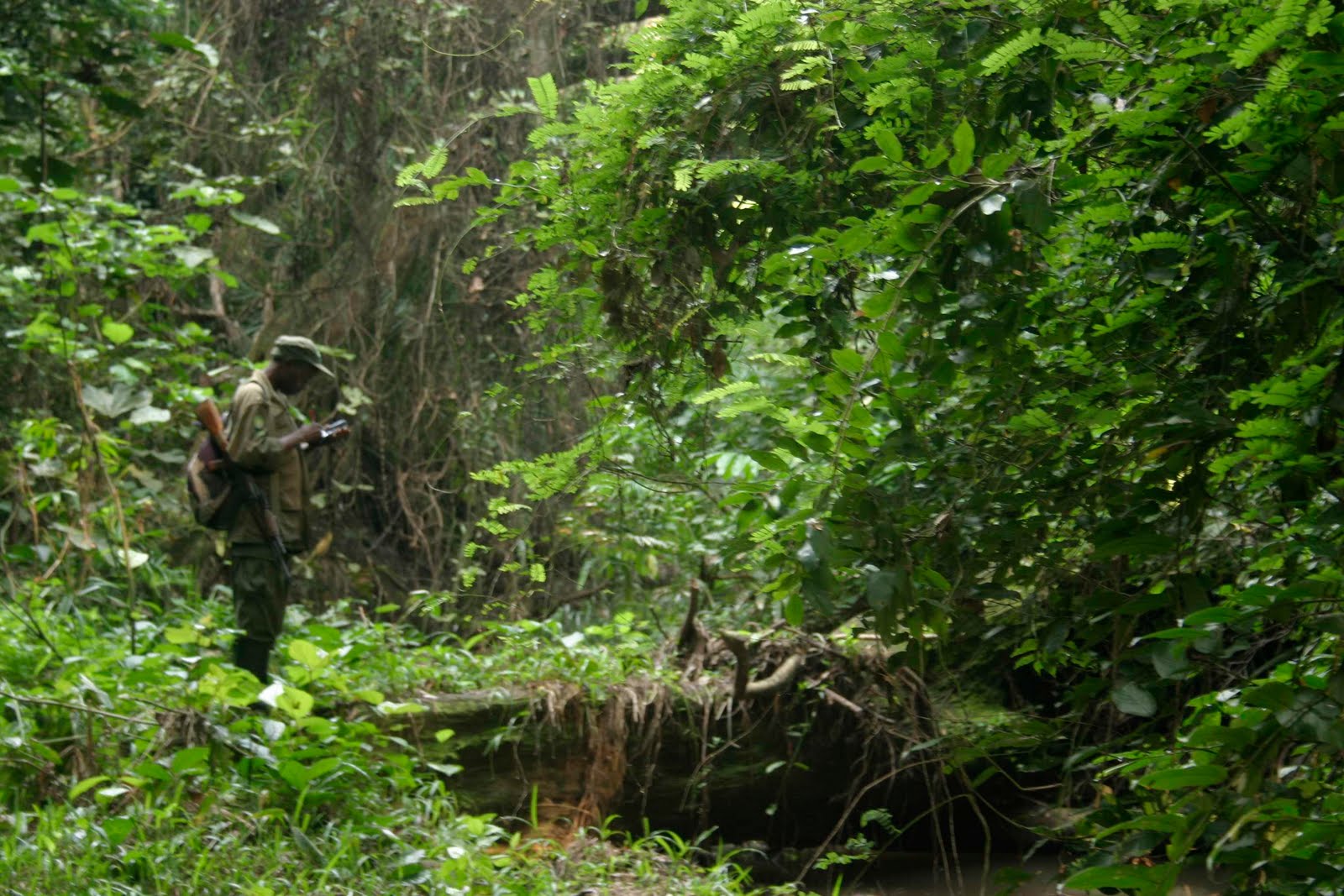
I loved the first river walk this morning and it was great to get a change of scenery from the now familiar trails. I felt very intrepid wading through the river, clambering over logs and debris and pushing through overhanging vines with my notebook in hand.

The first walk yielded four wells, 3km of mapping and many interesting sights along the way, perhaps the best of these being the seemingly never-ending line of ants we encountered. The ants were in the process of moving to a new headquarters and so the whole colony was on show, from the tiny white grubs and the multitude of workers carrying these to the large and viciously-jawed soldiers that guarded the procession.

Overall I would regard my first river walk as a success and so I will not even think of complaining when I have to put on damp boots tomorrow, as unpleasant as this may be! I am looking forward to the river walks to come and hope that they will enable me to begin to unravel some of the mysteries surrounding the well-digging practice of the Semliki chimpanzees.

Written on Friday 23rd July

Tuesday, 27 July 2010

A trip into town

Every other Wednesday here is set aside as the day for the camp supply trip to Fort Portal. As we needed to stock up on snacks and were keen to eat a meal that didn’t consist largely of beans and plantain, Duncan and I jumped at the opportunity to join Edson on this trip into town.

We left early, aiming to avid the roadworks that are going on along the road to Fort Portal. Unfortunately the previous night’s rain had made the road out of camp treacherous and Edson was forced to inch the car along, exhibiting some lightning fast reactions with the steering wheel as he corrected for the slipping and sliding of the wheels. With this delay we were unable to get past the roadblocks before the day’s construction work began meaning that the journey took longer than expected. It seems that even in Uganda road works are the bane of many a driver’s life!

Despite the hold-ups, and the fact that a blanket of cloud ruined my chances of a ‘stunning view down the Rift Valley’ shot, I thought that the drive into town was a success, if only because it was on this journey that I saw my first hammerkop.

The hammerkop is a bizarre bird found only in Africa that I have long wanted to see. The name, derived from the Afrikaans word for hammer-head, stems from the peculiar head shape that makes the medium-size brown bird look so odd. However, it is not just its appearance that is strange about this unique bird. Mated pairs of hammerkop build the largest nests of any bird species, some being so large that they are capable of supporting the weight of a small car!

Upon reaching Fort Portal my first thought, and one shared by Duncan, was “food”, or more specifically “meat”. Due to the cost and the difficulty in storing it, we rarely eat meat in camp, and for someone with carnivorous eating habits like myself this is difficult to take. A bacon omelette and pile of chips soon put my food craving to rest, and that was just breakfast!


Once fed, and after a trip to the bank, Duncan and I headed into the centre of town to explore and to search for the items on our shopping lists. Fort Portal is a bustling town with a relaxed and friendly atmosphere and it made a nice break from the isolation of camp. We finished our shopping and wandered around the town and I even discovered to my delight that Cadbury’s chocolate here tastes not unlike that found in the UK and is pretty damned good!

We also managed to find somewhere in town that claimed to be able to cut mzungu hair (mzungu being an African word used to mean ‘white person’), as Duncan was in need of a haircut. Unfortunately this in fact turned out to mean ‘we can massacre your hair so that you look like a doll that a small girl has played hairdressers with’, and so the only reasonable option was to shave it all off. Duncan therefore left Fort Portal with significantly less hair than he’d arrived with!

Chores done, we enjoyed a cold beer before heading back to camp in the car, that was now packed to the brim with various supplies. After two weeks living in tents in the middle of nowhere it was great to get a day in town, but I felt glad to see the thatched roofs appear from the savanna as we arrived back in camp that evening. Revitalised and with my meat cravings fed I am now ready to face some more chimpanzee chasing.

Written on Wednesday 21st July

Sunday, 25 July 2010

Noises in the night-time

It was somewhat unsettling when Edson gave Duncan and I a quick talk about what to do if we stumble across various dangerous animals in the dark, especially as most of the advice is followed by “and if you do that maybe you can get away”. Considering that I have not long got over my apprehension of nightly toilet trips the talk was perhaps less than helpful!

The fact that various creatures can be found close to camp at night is evident from the variety of sounds I hear emerging from the dark as I lie in bed. Owls and baboons are often heard, as is the late-night frog chorus and the scuttling of lizards across the tent roof. The deep bellowing grunts of a male lion sometimes adds to the racket along with stranger noises that I am unable to identify. Occasionally the animal sounds are accompanied by the pattering of rain, booming thunder and the howling wind. With all this going on the night-times can be incredibly noisy here!

One night I heard what sounded disconcertingly like a leopard as I walked back to the tent from the toilet. I told myself that it couldn't be a leopard, they are very rarely seen in this area and it would be unlikely for one to come so close to camp. The next morning I ask Edson what the source of the noise that appeared just before the baboons starting screaming was. “Oh that was a leopard” he cheerily replied.

It now seems that the chance of a leopard appearing out of the long grass in from of me in the dead of night has slightly increased. Perhaps worryingly, whilst the idea of anything suddenly emerging from the grass in the dark is somewhat unnerving, the thought of seeing a leopard excites me more than it scares me. That said, my heart still leaps into my mouth when a nightjar flies up in front of my face when I almost step on it one night!

Written Monday 19th July